Here is a fact that surprises almost every man who hears it: you are statistically likely to be happier at 68 than you were at 48.
Not "happier if things go well." Happier on average, across the population, almost everywhere on earth.
The economist David Blanchflower spent years testing this. In a 2020 study published in the Journal of Population Economics, he examined wellbeing data across 145 countries and found the same shape everywhere: life satisfaction slides downward through early adulthood, bottoms out somewhere in the late forties, and then climbs steadily for the rest of life.
The technical name is the U-shaped happiness curve. The plain-English version is kinder: the hardest years are behind you, and the data says the good ones are ahead.
Life satisfaction doesn't decline with age. It recovers.
Across 145 countries, self-reported wellbeing follows a U — falling through the thirties and forties, reaching its lowest point around age 47–50, then rising through the sixties, seventies and beyond.
Source: Blanchflower, D.G. (2020). "Is happiness U-shaped everywhere? Age and subjective well-being in 145 countries." Journal of Population Economics. Curve shown is illustrative of the reported shape, not plotted data.
Which raises an obvious question, and it's the one this article is about.
If men over 60 are, on the whole, more content than they've been in twenty years — why do so many of them describe feeling like they've become invisible?
Ask around. You'll hear it constantly, and rarely as a complaint. It comes out sideways. Nobody asks my opinion in meetings anymore. The waiter talks to my wife. I walked past three people I've known for years and none of them looked up.

Contentment went up. Visibility went down. Those two things are not the same, and the difference is where the discomfort lives.

 GIF
0.1 sec — before
0.1 sec — after
GIF
0.1 sec — before
0.1 sec — after
What people actually see — and how fast they decide
In 2006, Princeton psychologists Janine Willis and Alexander Todorov ran an experiment that has been replicated many times since. They showed participants photographs of faces for one tenth of a second — 100 milliseconds, roughly the length of a blink — and asked for snap judgements.
Then they let a second group look for as long as they liked.
The verdicts barely moved. Judgements made in a tenth of a second on trustworthiness, competence, likeability and attractiveness lined up closely with judgements made with unlimited time. Extra looking mostly made people more confident in the conclusion they'd already reached.
In controlled trials, judgements made after a tenth of a second correlated highly with judgements made with unlimited viewing time. Longer looking increased confidence — it rarely changed the verdict. The traits judged that fast:
Source: Willis, J. & Todorov, A. (2006). "First Impressions: Making Up Your Mind After a 100-Ms Exposure to a Face." Psychological Science, 17(7).
Read that again with your own life in mind. Every stranger you passed today reached a conclusion about you before you finished walking by. And the region they were looking at was your face.
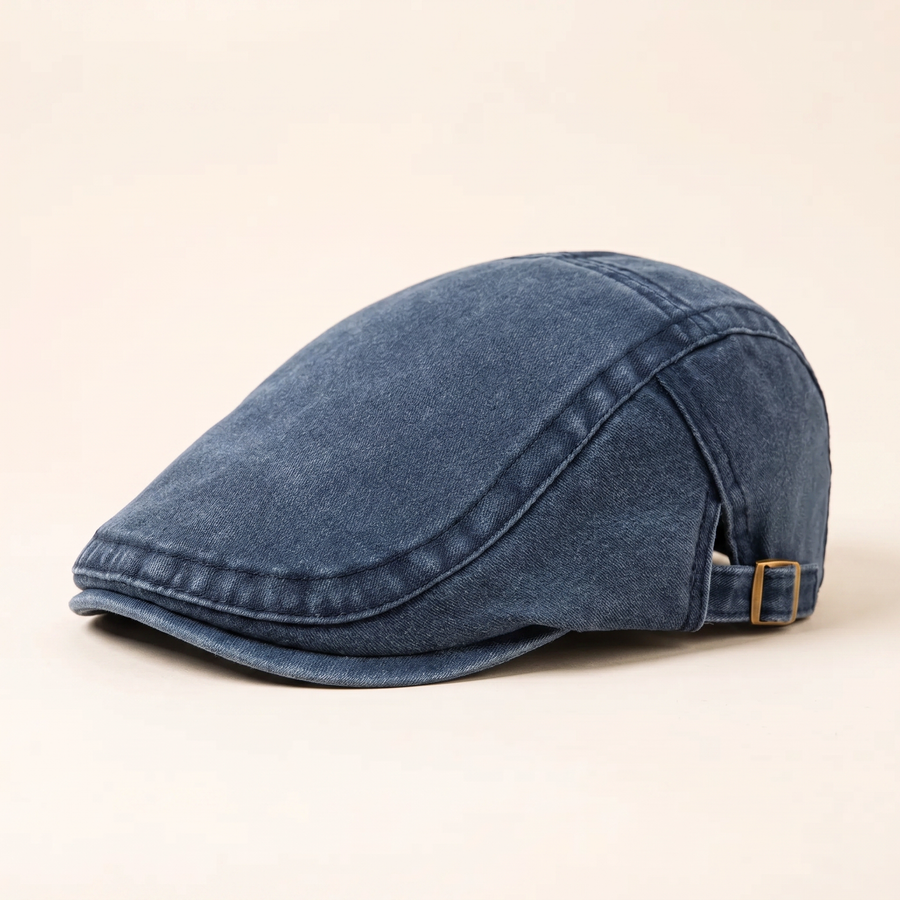
The Denim Vintage Cap
One adjustable size (52–62 cm) · Six colours
$60 $30 — 50% off today
The wardrobe plateau
Think honestly about what you wore this week versus what you wore ten years ago.
For most men past sixty, the honest answer is: functionally the same. The trousers are the same cut. The shirts are the same shirts, or their direct replacements. The shoes are comfortable and unremarkable, which is exactly what you want from shoes. The jacket has been in service since a wedding you'd have to think hard to date.
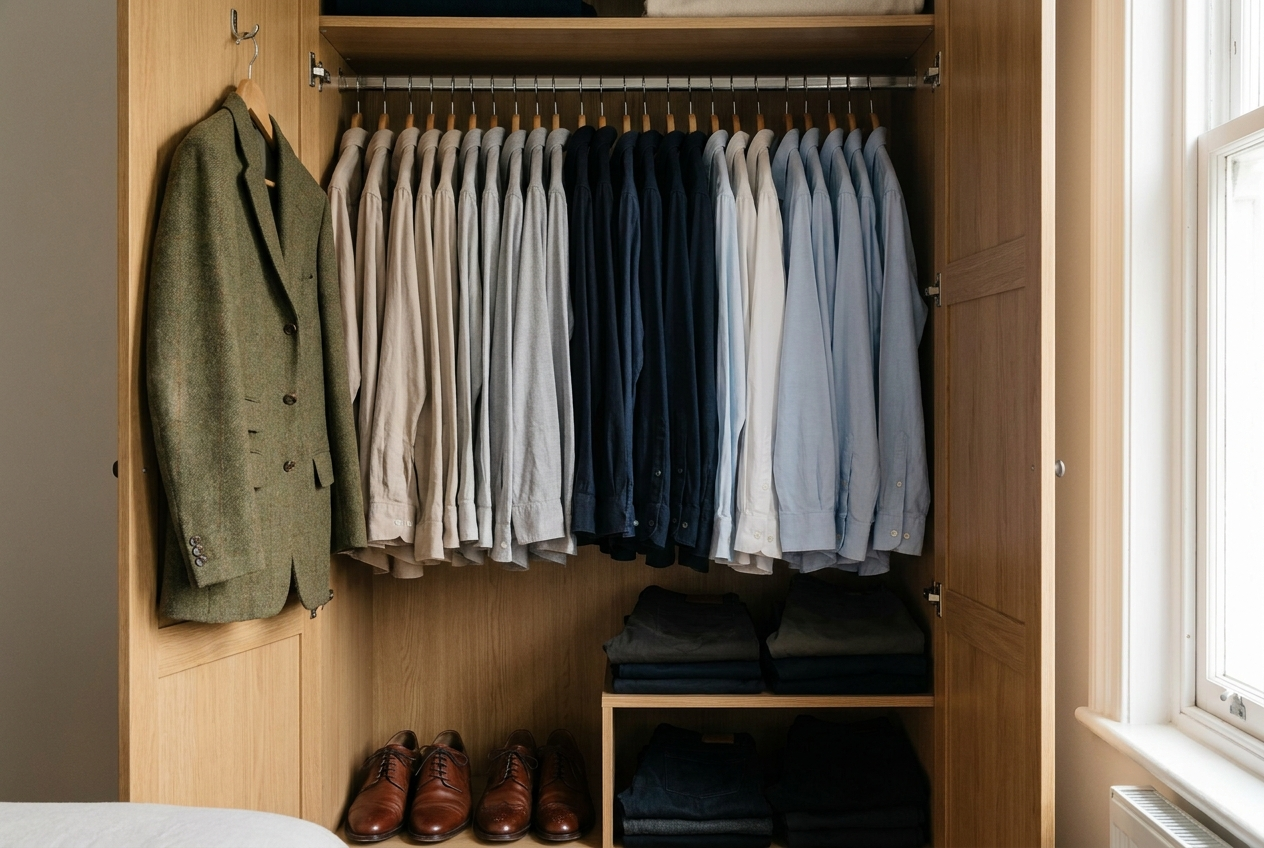
This isn't a failure. It's the reward for having worked out what you like. Most men reach a point — usually in their fifties — where the wardrobe stops changing because it no longer needs to. Call it the wardrobe plateau.
But the plateau has a consequence nobody mentions. If everything you own is interchangeable with everything you owned a decade ago, then there is nothing about your appearance that reads as a decision. And decisions are what people notice.
Now overlay that with the 100-millisecond finding. People are judging the top of you — the face and its immediate frame — and almost everything in that zone is fixed. Your face is your face. Your hair does what it does, and for most of us that's a conversation we've already had with ourselves.
There is exactly one item in the entire visible frame that is fully, freely, cheaply changeable.
How much of what you wear is actually changeable?
An illustration of the plateau: for a typical man over 60, most categories have settled — the same items, or their replacements, for a decade or more. Only one sits in the zone people look at first and can be changed today.
Note: This figure is an illustration of the argument made in this article, not the output of a study. The research cited elsewhere on this page concerns wellbeing, first impressions, clothing cognition and compliments.
Why the hat changes more than how you look
Here is where it stops being about other people.
In 2012, Hajo Adam and Adam Galinsky published a study in the Journal of Experimental Social Psychology that introduced a term now standard in the field: enclothed cognition. The finding was that clothing doesn't only change how others read you — it changes how you actually perform.
Participants wearing a white lab coat described as a doctor's coat performed measurably better on tests of selective attention. The same physical coat, described instead as a painter's coat, produced no such effect.
That detail is the whole point. The garment only worked when both things were true: the person was physically wearing it, and it carried a meaning they believed in.
The same coat. Two different meanings. Two different results.
Wearing a white coat described as a doctor's coat improved performance on attention tasks. Wearing the identical coat described as a painter's coat did not. Clothing affects the wearer only when its symbolic meaning is accepted.
Source: Adam, H. & Galinsky, A.D. (2012). "Enclothed cognition." Journal of Experimental Social Psychology, 48(4). Bars illustrate the direction of the reported effect, not effect sizes.
Now apply it. What does the cap on your hook mean — to you, privately, before anyone else sees it?
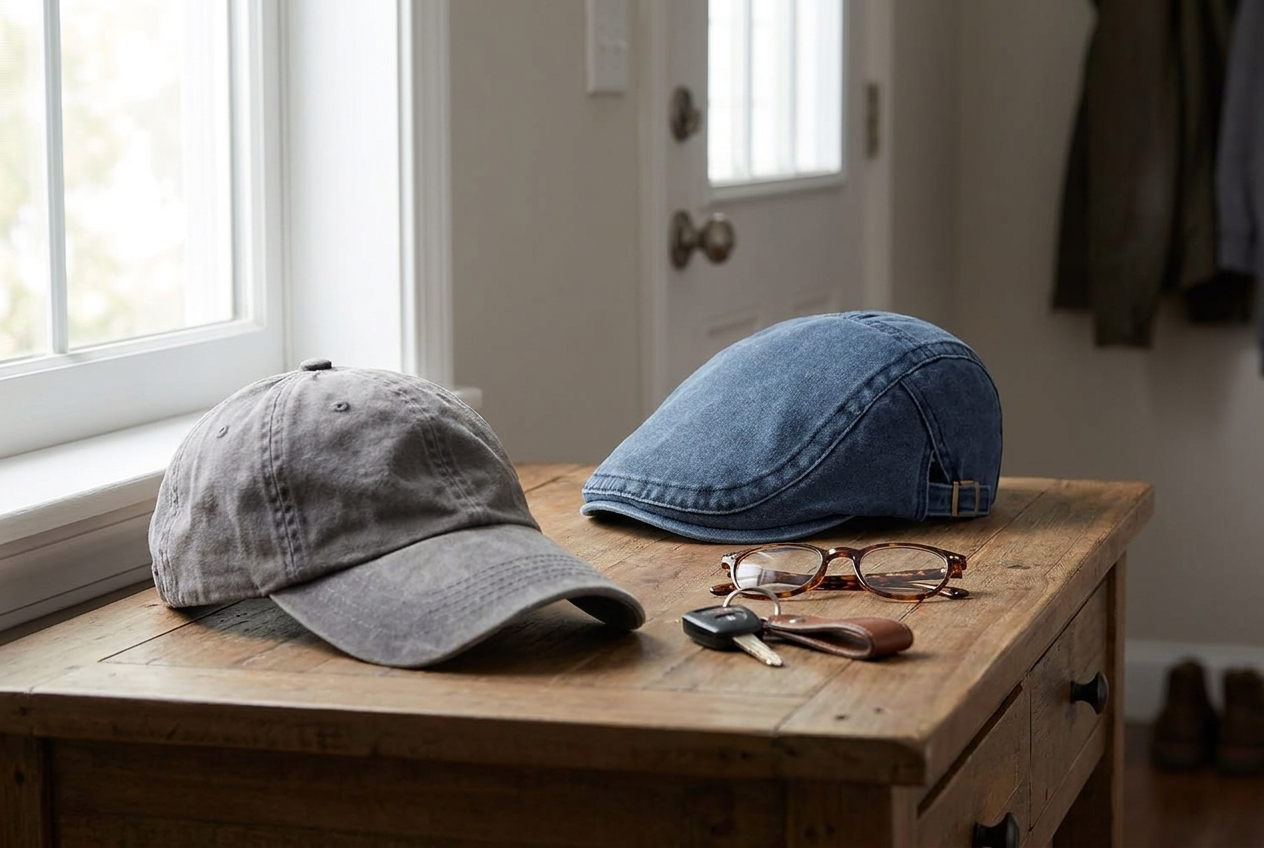
For a great many men the honest answer is: it means I've stopped bothering. Not consciously. But you don't look in a mirror when you put it on, and that itself is information.
Enclothed cognition suggests something uncomfortable and useful: a garment that means "I've given up" doesn't sit neutrally on your head. It works on you all day.
And the reverse is also true. Which brings us to the most serious finding in this article.
How you see yourself ageing may add years to your life
In 2002, Becca Levy and colleagues at Yale published a study in the Journal of Personality and Social Psychology that is still cited today, and it is worth reading the result twice.
They followed 660 people aged 50 and over, using attitude data collected up to 23 years earlier. The question was simple: did people who held positive self-perceptions of their own ageing live longer than those who didn't?
They did. By 7.5 years.
And the effect survived the obvious objections. It held after the researchers controlled for age, sex, socioeconomic status, loneliness and functional health. This wasn't healthier people feeling cheerful about it. The attitude came first.
Adults aged 50+ with more positive self-perceptions of their own ageing lived 7.5 years longer than those with more negative self-perceptions — an advantage that remained after controlling for age, sex, socioeconomic status, loneliness and functional health.
Source: Levy, B.R., Slade, M.D., Kunkel, S.R. & Kasl, S.V. (2002). "Longevity increased by positive self-perceptions of aging." Journal of Personality and Social Psychology, 83(2), 261–270. Bars illustrate the direction of the reported difference, not survival data.
Now hold that next to the mirror in your hallway.
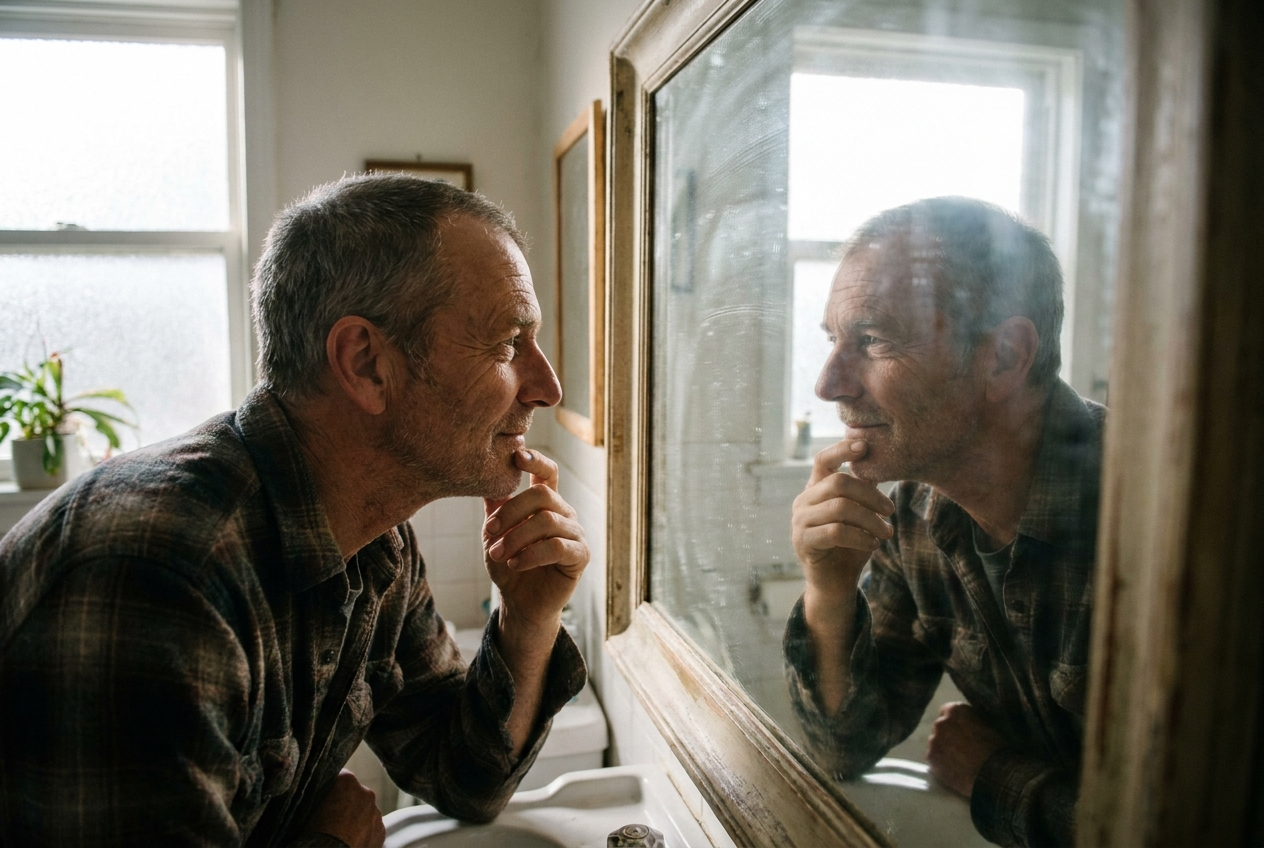
Nobody is claiming a hat extends your life. That would be absurd, and this article is not making that argument.
But Levy's work establishes something less obvious and more useful: the story you tell yourself about your own ageing is not decorative. It is one of the most consequential variables in later life.
And that story is not told in words. It's told in small daily evidence — including the thirty seconds each morning when you decide whether the man leaving the house is someone who still bothers.
Which is the entire mechanism behind what happened next.
The compliment nobody tells you about
One more study, and it's the one that explains the strange thing men report after making this change.
In 2021, Erica Boothby and Vanessa Bohns published research in Personality and Social Psychology Bulletin on why people don't give compliments. Across five studies they found that people who pay a compliment consistently underestimate how good it makes the recipient feel, and simultaneously overestimate how awkward it will be.
Recipients reported feeling meaningfully better than the giver had predicted. The result is a systematic shortfall: compliments that would have landed well are never spoken, because the person holding them is worried about the delivery.
People who compliment you underestimate how much it lands.
Across five studies, givers predicted recipients would feel less good — and more awkward — than they actually did. Which means the compliments you receive are the small surviving fraction of the ones people thought about giving.
Source: Boothby, E.J. & Bohns, V.K. (2021). "Why a Simple Act of Kindness Is Not as Simple as It Seems: Underestimating the Positive Impact of Our Compliments on Others." Personality and Social Psychology Bulletin, 47(5). Bars illustrate the direction of the reported gap.
Put the five findings together and you get a chain that's hard to argue with:
- You're already on the upswing. Wellbeing rises after the late forties — that's the baseline you're working from.
- People decide about you in 100 milliseconds, looking at your face and what frames it.
- Almost nothing in that frame is changeable — except the one item most men have not updated since the nineties.
- What you wear works on you too, but only if it carries a meaning you believe.
- How you see your own ageing is measurably consequential — positive self-perception tracked with 7.5 additional years of life.
- And when people notice, they say less than they feel — so a single spoken compliment represents several unspoken ones.
Which is the long way of explaining a very short observation: change the hat, and you change the first thing everyone sees, the thing you tell yourself every morning, and the number of times people say something out loud. All for the price of a decent lunch.
What 3,000 men said they actually wanted
The theory is fine. The practical question is what to put there instead — and the answer men keep landing on is not a fashion choice. It's the shape their grandfathers wore.
Two summers ago a small English hatmaker, Harrington & Co. Hatters, ran an experiment of its own. Before redesigning its flagship cap, it emailed every customer over 60 it had — satisfied and dissatisfied — and asked one open question: what actually matters to you in an everyday hat?
More than 3,000 men wrote back. Five answers dominated:
The five requirements, in order of how often they came up
Source: Harrington & Co. Hatters customer survey, 3,000+ written responses, as published by the company. Company-reported figures.
Those five answers became the specification for the cap they now sell — the Denim Vintage Cap. The polyester lining, the plastic closure and the tall crown were all removed as a direct result of what the survey said.
What it is, in plain terms
- Fits your head, not the other way around. A soft inner band with two brass side buckles adjusts from 52 to 62 cm (20.5"–24.4"). Set it once.
- No plastic, no foam. Which is why there's no pressure line and no mid-afternoon headache.
- Breathable washed organic cotton. Works in July, not just November.
- Low, structured profile. Wind goes over it rather than under it.
- Six muted colours — Denim Blue, Coal Black, Tobacco Brown, Beige, Field Olive, Rosewood Red — that match a wardrobe you already own.
- Handmade in small batches, with real brass hardware and a proper lining.
The cap 35,000 men switched to
Handmade by Harrington & Co. Hatters
$60 $30 — 50% off today
What men report afterwards
More than 35,000 men have now made the switch, and the company's rating sits at 4.8 out of 5 across more than 6,000 reviews.
What's striking isn't the praise for the product. It's how consistently the reviews describe the second-order effects the research above would predict — being noticed, being spoken to, and feeling different in yourself.

And by a wide margin, the single most common sentence in the company's inbox is some version of: "my wife says it's the best thing I've put on in years."
Which, if you've read this far, should no longer sound like a coincidence. It is precisely what five separate bodies of research would predict happens when a man changes the one visible thing he has been able to change all along.